











Individual / Indie
Solo developers, hobbyists, and makers
- Applies to accounts created after Nov 13, 2023
- $25 fee, identity and contact checks, an Android device check
- Fastest to set up - minutes to register
Registered Business
Companies, studios, and regulated apps
- Needs a business Google can verify, usually with a D-U-N-S number
- Verified website and business documents
- Slower to set up: Google says a D-U-N-S number can take up to 30 days
Quick Answer
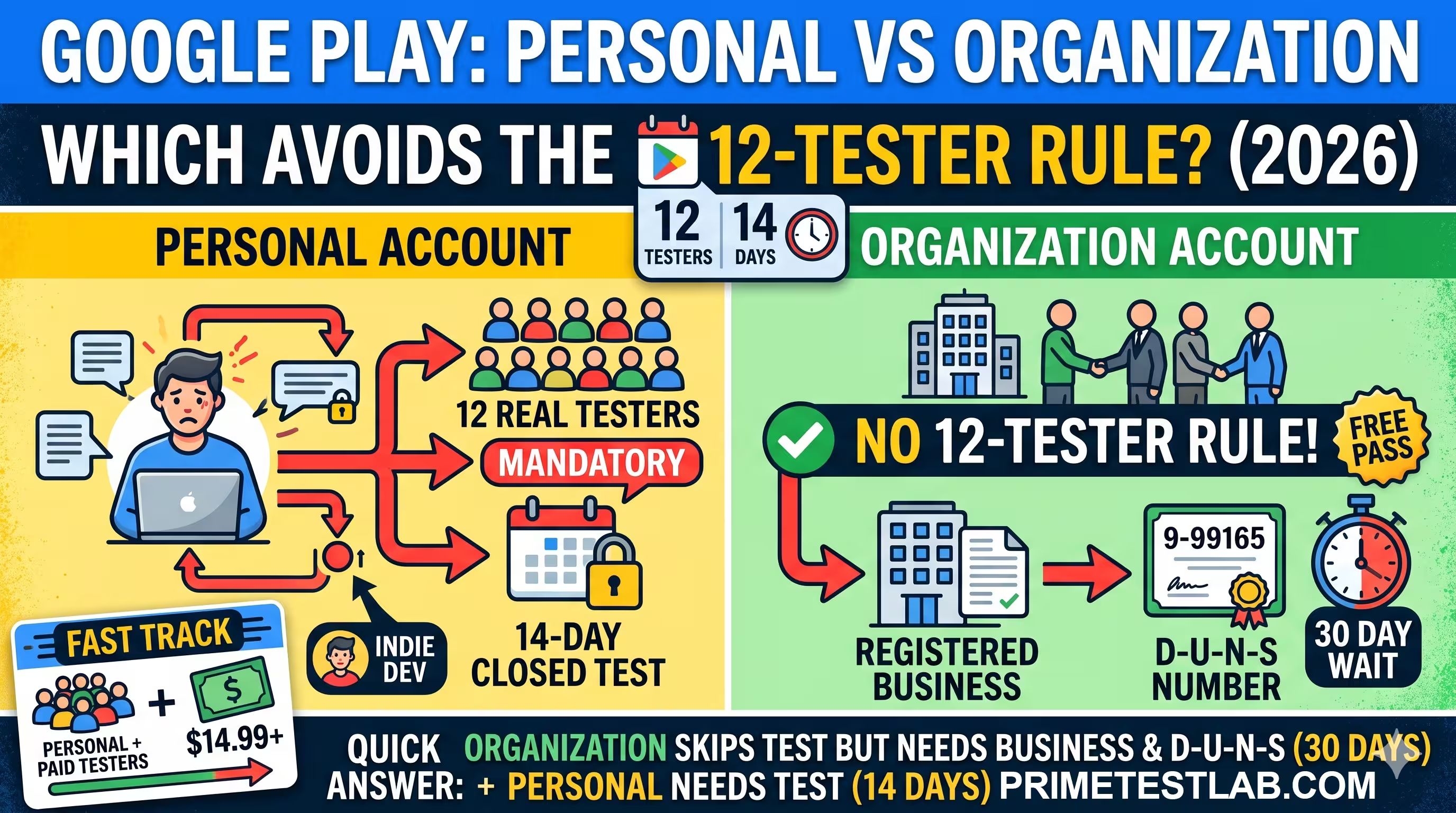
Organization Google Play accounts are outside the 12-tester, 14-day closed testing rule; personal accounts created after November 13, 2023 are not. An organization account needs a business Google can verify, usually with a D-U-N-S number that Google says can take up to 30 days, so choose the account that matches who publishes the app rather than forming a company just to skip the test. Picked personal by mistake? Google now documents a conversion path. PrimeTestLab supplies 12 real, opted-in testers from $19.99 plus a 5% service fee ($1.50 minimum), with testing starting within 4-6 hours.
If you just created a personal Google Play developer account and hit the wall that says you need 12 testers for 14 days, you have probably already asked the obvious question: can I skip this by registering as an organization instead? The short version is yes - the rule is written to apply only to personal accounts. The longer version is that "just pick organization" is not free, fast, or available to everyone, and for a lot of developers it is the slower path. This guide lays out exactly who the rule applies to, how the organization exemption really works, what it costs in time and money, and how to decide which path fits you. It is current as of October 16, 2026.
In this guide
Which Account Type Skips the 12-Tester Rule?
Google Play has two developer account types: personal and organization. The mandatory closed testing requirement is scoped to personal accounts created after November 13, 2023. Organization accounts are not named in that rule, so a verified organization account is not asked to run the 14-day test before production access. App review and every other policy still apply.
The catch is that an organization account represents an organization or business that Google can verify, usually with a D-U-N-S number, so it is not a box a hobbyist ticks to avoid testing. That single fact is what turns this from a simple toggle into a real decision, and it is the decision the rest of this guide helps you make.
The honest framing: organization accounts skip the test not because Google rewards businesses, but because the rule was written only for personal accounts. The exemption is real, but it is an exemption by omission - so it is best treated as highly likely rather than a written guarantee. We dig into that nuance below.
Decision Tool: Which Path Fits You?
Before the deep detail, get a fast read on your own situation. Answer four questions and this tool gives you a recommendation based on the same factors developers actually weigh: whether you already have a business, your app category, how many apps you ship, and your timeline. Nothing is sent anywhere - it runs entirely in your browser.
Personal or Organization: What Should You Pick?
Four quick questions. Your answer updates live as you go.
For a solo developer publishing as an individual, the personal account plus a clean 14-day closed test is usually the simplest route. Choose the account that represents who publishes the app; forming a company only to avoid the test is rarely the right reason.
The one genuinely hard part is finding 12 testers who stay active for 14 unbroken days - which is exactly what PrimeTestLab handles, from $19.99.
An organization account lets you publish under your business name, and the 14-day testing requirement is not in scope. You will usually need a D-U-N-S number, an official website you can verify, the business documents Google lists for your country and the representative's ID. Already registered as personal? Google documents a conversion path.
Apps that provide the financial, health, VPN or government services Google lists must use an organization account regardless of the testing rule, and local-only storage is not an exception. Get your D-U-N-S number and organization documents in order before you build.
What the 12-Tester Rule Actually Says
Google's Play Console Help article on testing requirements for new personal developer accounts states that you must run a closed test with at least 12 testers who have been opted in for at least the last 14 days continuously before you can apply for production access. Four details trip developers up:
It is 12, not 20
Google cut the minimum from 20 testers to 12, live in Play Console on December 11, 2024. The 14-day duration did not change. Any article still saying 20 is out of date - we cover it in the 20-to-12 change.
"Continuously" is literal
The 14 days must be consecutive. If a tester opts in, leaves, and opts back in, their clock resets. Testers must be real people on real Android devices with genuine Google accounts, actually using the app during the window.
Only closed testing counts
Internal testing (up to 100 testers) and open testing do not satisfy the gate. Closed testing is the only track that unlocks production access - see internal vs closed vs open testing.
There is a review after
Meeting the 14 days does not auto-publish. You apply through a three-section questionnaire and Google reviews it; review usually takes seven days or less, but can occasionally take longer. We break it down in the production access answers.
This rule applies only to personal accounts created after November 13, 2023. Personal accounts created before that date, and organization accounts, are not in scope. That scoping is the entire basis of the organization "exemption" - which is worth examining closely, because it is not quite as absolute as it sounds.
Are Organization Accounts Really Exempt?
Mostly yes, with one honest caveat. Google's testing-requirements documentation only ever names personal accounts. The company does not publish a sentence that says "organization accounts are exempt." The exemption is an inference from how the policy is scoped, not an affirmative promise.
How to read it: the exemption is best understood as how Google structured the policy, not a loophole you are exploiting. Google's registration page says the testing requirements apply to personal accounts created after November 13, 2023, and organization accounts fall outside that scope. But because it is defined by scope rather than stated outright, it is not airtight.
If a verified organization account still shows a closed-testing restriction for an app, do not assume the exemption will clear it on its own. Check that app's Dashboard and contact Play support. So treat the exemption as highly likely rather than a hard guarantee.
Verify It in Your Own Console
Before you build a launch plan around skipping the test, confirm the exemption inside your own verified organization account. If the closed-testing prompt is showing for you, do not assume it is a bug and ignore it - resolve it in Play Console first. Building around an assumption you have not checked is how launches slip.
Picked Personal by Mistake?
If you publish for a business and registered a personal account by mistake, you do not have to start over. Google documents converting a verified personal Play Console account to an organization account, as long as the organization details meet its requirements.
Before the option appears
- You are the account owner.
- Your personal account verification is complete.
- You have requested verification of the organization's official website.
- You can create or select an organization payments profile with the legal name, address, D-U-N-S number and documents Google asks for in your country.
The conversion path in Play Console
- Open Developer account > About you.
- Select Change account type, then create or select the organization payments profile.
- Enter the organization and contact details, the organization type and size, and upload the evidence Google requests.
- After verification, return to the account page, link the verified profile and confirm the change.
Conversion is not instant production access. Google asks you to allow at least 72 hours after the conversion completes before you submit new apps, and every other review and policy check still applies.
Can't see Change account type?
Work through the four prerequisites above first, including the website verification request. If they are complete and the option is still missing, contact Play support with your account state and the steps you have done. A missing button alone does not mean you need another account.
Picked organization but need personal?
That direction has no conversion. Google says it does not support changing an organization account to an individual one: you would open a new personal account, verify it, and move apps across with an app transfer. A transfer keeps users and listing history, but test groups do not move between accounts, so a closed test would have to be set up again.
Personal account, but asked for business documents?
First work out which check is asking: the developer account identity or the merchant payments profile you use to sell. Developers have reported finishing a Play account conversion while merchant payout verification stayed blocked, because they are separate checks. Keep the notice, your profile type and your real business documents together when you contact support, and do not choose a legal form that does not describe you.
If personal was the right account after all and the closed test is what remains, see how 12 managed testers for the 14-day test work.
Can a Solo Developer Just Choose "Organization"?
Not just by selecting it, and this is the part that catches people. Google asks you to choose an organization account when you publish for an organization or business, and to verify one it usually needs a D-U-N-S number and business details it can check. Its wording on the number is blunt:
"We will not accommodate any exemptions or provide extensions for any organization accounts that fail to provide a D-U-N-S number." Google Play Console Help
So "organization" is not a label you can pick to dodge the test. Google's payments definitions treat most freelancers and consultants who are not registered as an organization as individuals, and an unregistered freelancer should not expect a D-U-N-S number alone to be enough. Forming a company is not a universal prerequisite either: some registered sole proprietors report passing organization verification, as the sole trader section shows. What decides it is whether Google can verify your business with the documents it lists for your country.
Do Not Fake a Business
Fabricating a business entity or using fraudulent corporate credentials to bypass the rule is a Terms of Service violation that can lead to permanent account termination. The organization route is legitimate only if you have, or are willing to create, a genuine business. There is no shortcut that involves making one up.
Sole Trader or Freelancer: Which Account?
Being a sole trader does not automatically rule out an organization account, but a D-U-N-S number does not guarantee Google will verify it.
Google asks you to choose an organization account when you publish for an organization or business. Its payments definitions treat most solo business owners, such as freelancers or consultants who are not registered as an organization, as individuals. So the question is whether you run a registered business that Google can verify with the documents it lists for your country, not whether you work alone.
Dun and Bradstreet accepts D-U-N-S applications from sole proprietors, and developers in several countries report passing organization verification as registered sole traders. None of these reports is a promise for your country or your documents.
| Country | Business record | Reported result |
|---|---|---|
| Turkey | A sole proprietorship | A developer reports converting a personal account to organization (April 2025) |
| Australia | An ABN and a registered business name | A commenter reports converting to organization (2025) |
| India | Udyam registration, then a D-U-N-S number | The developer reports the organization route working (May 2026) |
| Germany | A trade registration (Gewerbeanmeldung) for a sole trader | Documents reported accepted after a name was corrected on the D-U-N-S record (February 2026) |
| Korea | A personal business D-U-N-S record | Record correction and signup described; final verification not shown (October 2026) |
Community reports, not Google policy. Each describes one developer's documents and outcome.
Local-only app in a finance or health category?
Local-only storage is not an exemption from Google's organization-account rules. Apps that provide the financial, health, VPN or government services Google lists must be published from an organization account, and whether a health journal falls in that list depends on what it does, not on where it stores data. Compare the app's real features and declarations with Google's health categories before you recruit testers.
Have a D-U-N-S number but verification still failed?
The number is only part of verification. Check the legal name and address on the D-U-N-S record against your payments profile and the documents you submitted, then the authorized representative's identity requirements. One reported German case passed after a middle name was corrected on the record, but that does not explain every rejection; follow the notice you received.
What an Organization Account Requires in 2026
Registering as an organization is a heavier process than a personal account. Here is everything Google asks for, and the detail that fails the most verifications is the matching: your legal name and address must be identical across the D-U-N-S record and your Google Payments profile.
D-U-N-S Number
A 9-digit Dun and Bradstreet ID, mandatory with no exemptions except certain government bodies or unsupported regions.
MandatoryLegal Name & Address
Must match the D-U-N-S record and your Google Payments profile exactly. Any mismatch across the three can trigger a verification failure.
Must matchVerified Website
Your organization's official website, with ownership verified through Google Search Console or the Play association step. Social media profile URLs cannot be verified.
Domain you ownOfficial Documents
The registration documents Google lists for your country, plus identity evidence for the authorized representative. In the US that can be a stamped IRS letter (CP575 or 147C) or a state certificate of incorporation; other countries have their own lists.
Business proof$25 Registration Fee
The same one-time fee personal accounts pay, by credit or debit card. It never recurs.
One-timeIdentity & Payments
Google verifies the organization's identity and, if you sell, your merchant payments profile. These are separate checks with their own timing; Google's five-day figure applies to merchant payment method verification, not to every identity check.
Separate checksBy contrast, a personal account needs a developer name, verified contact details, identity verification, a check that you can access a physical Android device (for new personal accounts), and the $25 fee. No D-U-N-S number or business documents. That gap is the main reason a personal account is faster to open, and it is the account type that carries the testing requirement.
How Long a D-U-N-S Number Takes, and What It Costs
This is the single biggest reason the organization path is slow. A D-U-N-S number is free through the standard route, but the turnaround is long, and each source states it differently: Google says up to 30 days, while Dun and Bradstreet's standard US route says up to 30 business days. Use the estimate for the route you actually apply through. During that window you cannot finish organization verification, so you are effectively paused.
Apple's Route Is Not a Google Shortcut
Apple's D-U-N-S page gives its own timings for Apple enrollment: up to five business days to issue the number, then up to two business days for Apple to receive it. Those are Apple's figures for Apple's program, not a Google Play promise, and Apple's rules for sole proprietors are its own. If you already hold a D-U-N-S number from any route, look it up and check that the record is accurate before you apply for another.
Ignore the Upsells and Watch for Scams
Dun and Bradstreet representatives often push paid credit-building packages. You do not need any of that for Google Play: Dun and Bradstreet says you never have to buy a product to obtain, use or maintain the number, and it does not expire. Treat any invoice that says you must pay to renew it with suspicion and check it with Dun and Bradstreet directly. Do keep the record accurate, because Google checks it against your organization details.
What It Costs to Form a Business Just to Skip Testing
If you do not already have a business, forming one purely to avoid the test adds work that continues after your app ships: formation, local filings and taxes, the D-U-N-S wait (Google says up to 30 days), and organization verification. How long and how much depends on where you are, so compare your real local obligations with the testing work you still need. Here is how the two routes compare:
Form an entity + org account
To avoid the test by going organization.
Worth it when the publisher or the app category calls for an organization
Personal + 14-day test
Keep the account you already have.
Usually simpler for a solo developer publishing as an individual
Some States Make Path A Far Worse
Costs vary enormously by US state. California has an $800 general annual LLC tax, with some exceptions, even if the app earns nothing. New York requires most new LLCs to publish a formation notice in two designated newspapers for six consecutive weeks and then file a certificate of publication; the cost depends on the county. Outside the US, the obligations are different again, so check your own jurisdiction before you treat a company as a shortcut.
Personal vs Organization: The Honest Comparison
Everything above, side by side. Green marks the clear advantage, and flagged rows mark an added cost, a delay, or the hard blocker. The pattern is consistent: personal wins on speed and simplicity, organization wins on skipping the test - at the price of time, money, and paperwork.
The Migration Trap: Upgrading Mid-Project Rarely Helps
A common assumption is that switching account types means starting over, or the opposite: that converting skips the test for an app straight away. Neither is quite right. Google now documents converting an eligible, verified personal account into an organization account in Play Console, so you keep the account. The conversion path is in the picked-personal-by-mistake section.
Personal account
Verified, and the organization details are ready
Organization account
Converted in Play Console, not registered from scratch
The trap is in the details. Conversion needs completed personal verification, a website verification request and an organization payments profile Google can verify, and Google asks you to wait at least 72 hours after it completes before submitting new apps. It does not make a pending review or rejection disappear. Moving an app to a different account is a separate process, an app transfer: users and listing history move with the app, but test groups (internal, closed and open) do not transfer, and services linked to the old account may need to be relinked.
The Takeaway
Decide your account type by who publishes the app, not by the testing wall. If you publish for a business, set up or convert to the organization account first. If you are staying personal, plan the 14-day test into your launch from day one so the clock runs while you finish the app.
When Is Forming an Entity Actually Worth It?
Use this as a quick decision framework. Find the row that sounds like you, and the recommended path is on the right:
Solo developer, no business, shipping one app
Keep your personal account and complete the 14-day test. Usually the simplest route: start the test as early as your build allows so the clock runs while you finish.
You already run a registered business or hold a D-U-N-S number for it
Register, or convert your personal account to, an organization account that represents the business. The testing requirement is not in scope, though review and policies still apply.
Your app is finance, health, government, or VPN
An organization account is effectively required regardless of the testing rule, and local-only storage is not an exception. Start the D-U-N-S process early; in the US, a $229 expedited option exists.
You publish as a studio or business with several apps
Each new app on a personal account needs its own qualifying closed test, but those tests can overlap, so there is no fixed number of apps that makes a company pay off. If you already publish as a business, use the account that represents it.
You are in a high-cost state like California or New York
California's $800 annual franchise tax or New York's publication fees tilt a single-app decision further toward simply doing the test on a personal account.
Two 2026 Changes That Do Not Decide It
Both of these get raised in account-type discussions, but neither one settles the personal-vs-organization question, because both apply to either account type:
Android Developer Verification
A separate identity check, not a testing rule. From September 30, 2026, apps installed on certified Android 7 and later devices through participating stores in Brazil, Indonesia, Singapore and Thailand must come from verified developers, with a global expansion planned for 2027. Organizations verify with a D-U-N-S number and a verified website.
Enforcing Sept 30, 2026API 36 (Android 16) targeting
New apps and updates for phones must target Android 16 (API level 36) or higher since August 31, 2026, with extensions available to November 1, 2026. It is a technical deadline that applies no matter which account type you use, so it is a build task, not an account-type factor.
From Aug 31, 2026How PrimeTestLab Helps
If you are on a personal account - the common case for indie developers - the 14-day closed test is your fastest route to production. The hard part is rarely the 14 days; it is finding 12 committed testers on real Android devices who actually open the app and engage with it, because that engagement is exactly what Google checks before granting production access.
That is the gap PrimeTestLab fills. You get real, opted-in testers on real Android devices with full 14-day coverage, testing that starts within 4-6 hours, a 99.9% success rate across 12,100+ apps, and coverage spanning 120+ countries.
Even If You Qualify for the Exemption
Closed testing is still good practice. It catches the Day-1 crashes and broken flows that tank your early ratings, so skipping it just because you are allowed to is not always the smart move. A clean test run protects your launch whether or not Google requires it.
Current Packages
Starter
12 Testers
$19.99
Enterprise
25 Testers
$27.99
Professional
25 Testers
$59.99
Money-back guarantee · Testing starts in 4-6 hours · No subscription
See current options on the pricing page, read the step-by-step process, or if you want a recommendation for your app, message us on WhatsApp. The extra testers in the larger plans act as a buffer against drop-offs, which is worth understanding if you are weighing plan sizes - we cover that in why you may need more than 12 testers. Plan prices are plus a 5% service fee ($1.50 minimum). If Google does not grant production access after the full test, you choose a free retest or a full refund.
Frequently Asked Questions
Do organization Google Play accounts need 12 testers?
No. Google's testing requirement applies to personal developer accounts created after November 13, 2023, so organization accounts are outside its stated scope. That does not waive identity checks, app policies or review. Google does not publish a sentence that says organization accounts are exempt, so if a verified organization account still shows a testing restriction, check that app's Dashboard and contact Play support.
Can I switch from personal to organization to skip the test?
Google now documents converting an eligible, verified personal account to an organization account in Play Console, so you do not have to open a new account. Convert because the organization account fits who publishes the app, not as a shortcut: organization verification comes first, Google asks you to wait at least 72 hours after the conversion before submitting new apps, and it does not make a pending review or rejection disappear.
Can a sole proprietor get an organization account?
Some registered sole proprietors report doing so, and Dun and Bradstreet accepts D-U-N-S applications from sole proprietors. What matters is whether Google can verify your business with the documents and identity details it requires in your country. An unregistered freelancer should not assume that a D-U-N-S number alone makes an organization account appropriate.
How long does a D-U-N-S number take?
Use the estimate for the route you apply through. Google says the free route can take up to 30 days, and Dun and Bradstreet's standard US route gives up to 30 business days. In the US, its expedited option costs $229 with an estimate of up to eight business days. Issuance is only one stage: record corrections and Google's own verification come afterward.
Is it worth creating a business just to avoid the 12-tester rule?
Compare the real business obligations with the testing work you still need. A company brings filings, taxes and ongoing administration, such as California's $800 general annual LLC tax, and no fixed number of apps makes it worthwhile. If your app or publisher requires an organization account, resolve that requirement. Otherwise, a personal account is usually simpler than forming a company only to avoid the test.
What is the fastest way to pass closed testing on a personal account?
Prepare a working release, recruit testers who stay opted in for the full 14 days and actually use the app, and act on their feedback before you apply. Google says review usually takes seven days or less but can occasionally take longer, so there is no fixed approval date. If recruitment is the missing piece, PrimeTestLab provides 12 real opted-in testers from $19.99 plus a 5% service fee ($1.50 minimum), with larger 25 and 25 tester packages for spare capacity. If Google does not grant production access after the full test, you choose a free retest or a full refund.
Does Android Developer Verification replace closed testing?
No. Android developer verification is an identity requirement for apps installed on certified Android devices, enforced from September 30, 2026 through participating stores in Brazil, Indonesia, Singapore and Thailand, with a global expansion planned for 2027. Closed testing is a separate production-access gate for new personal accounts. Completing one does not satisfy the other.
Bottom Line
Summary
Organization accounts are outside the 12-tester, 14-day rule, but only for a business Google can verify, usually with a D-U-N-S number that Google says can take up to 30 days. Choose the account that represents who publishes the app: some registered sole traders qualify, and a personal account picked by mistake can be converted once the organization details are verified. For a solo developer publishing as an individual, the personal account plus a clean 14-day closed test is usually the simpler path. PrimeTestLab gets you through that test with real, engaged testers from $19.99 plus a 5% service fee ($1.50 minimum), with testing starting within 4-6 hours. See pricing plans →