














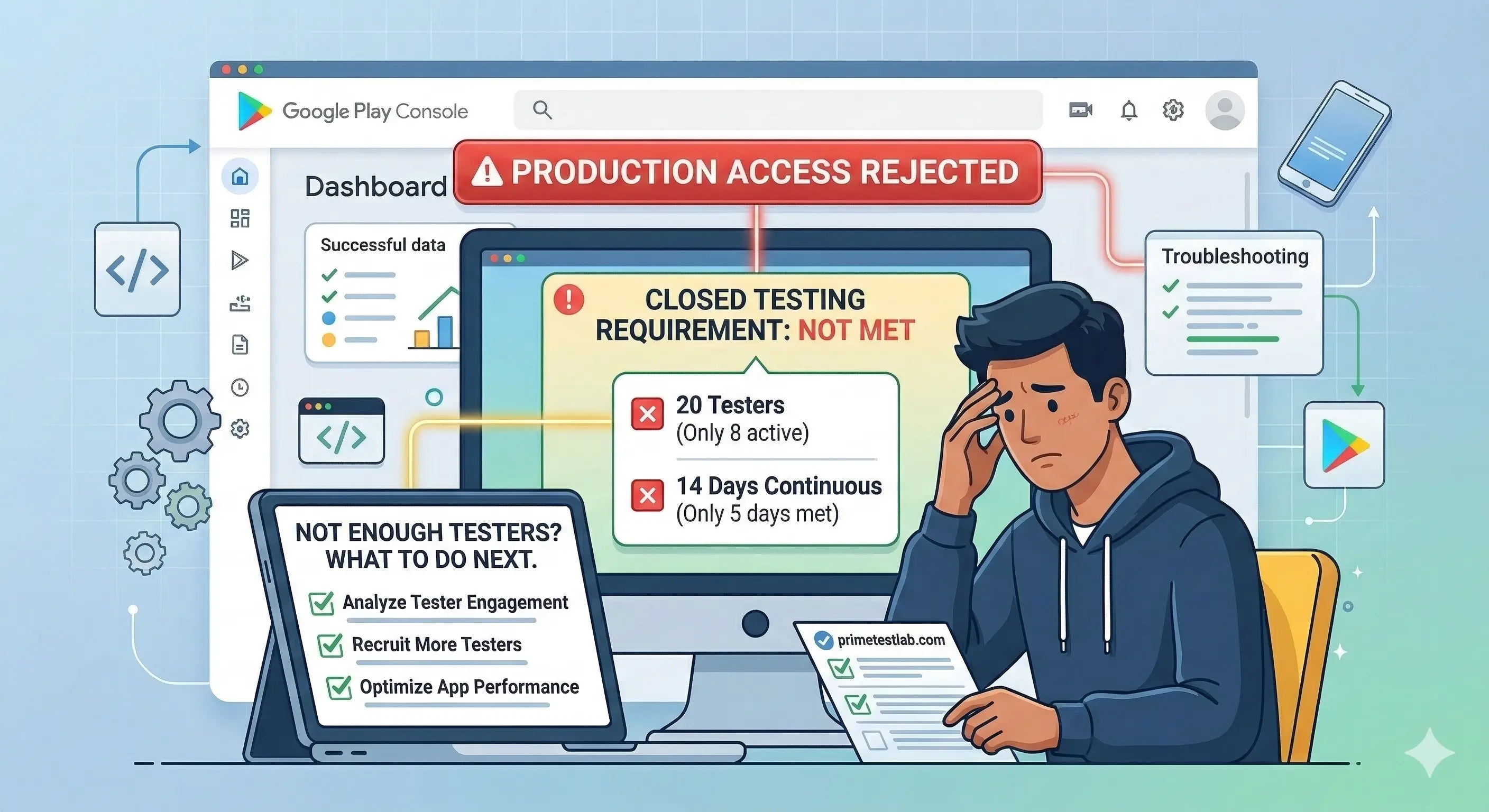
Rejection reason
"Not enough testers"
Google flagged your closed test before granting production access. Here is exactly what that phrase means, and how to clear it.
What Google actually checks
At least 12 opted-in testers. Lose one and you fall to 11 - below the minimum.
14 continuous days. Each tester needs 14 unbroken days; one who leaves and rejoins starts over.
Applies to new personal accounts created after Nov 13, 2023
Quick Answer
Minimum 12 opted-in closed testers + 14 consecutive days for new personal accounts created after November 13, 2023. If you dropped below 12, had opt-outs, or low engagement, Google may say you need more testing.
Fastest path: add reliable testers (ideally more than 12), keep them opted in, make sure they actually use the app, then reapply.
Need a reliable fix today? PrimeTestLab provides 12 to 25 real testers with a quick start and support for the full 14-day test, starting at $19.99 plus a 5% service fee ($1.50 minimum).
A tester just left your test?
Work out which of these happened before you change anything:
- A tester opted out on day N: check whether 12 other testers are still continuously opted in.
- Only the install count fell: an uninstall is not proof that someone left the test.
- The day counter changed: record what you see and investigate before you rebuild anything.
On This Page
Why Google Play Says "Not Enough Testers"
Google's production access review is checking one core thing: whether your closed test meets the criteria for your account type.
For new personal developer accounts, Google explains that you must run a closed test with a minimum of 12 testers who have been opted in for at least the last 14 days continuously before you can apply for production access.
If your app is not ready, you may be required to continue testing, including cases where you do not have 12 opted-in testers or your testers are not engaged.
When your submission does not meet those criteria - or your testers are not engaging - Google may respond that your app needs more testing, or that you do not have enough testers.
Who the Tester Requirement Applies To (And Why You Got Blocked)
This is where many developers get surprised.
Google states that in November 2023 it changed publishing requirements and that these changes require developers with personal accounts created after November 13, 2023 to meet specific testing requirements before publishing new apps to production.
*Organization accounts may still face review. Always confirm in your Play Console and Google's docs.
If you are still thinking it is "20 testers": On December 11, 2024, Google announced it was requiring 12 instead of 20 testers for personal developer accounts. Read our full breakdown of the 20-to-12 change.
The Difference Between Invited Testers and Opted-In Testers
This one causes a lot of "but I added 12 emails" confusion.
Adding testers to your list is not the same as them being opted in.
- You added their emails to a list or Google Group
- They may not know they were added
- They have not clicked the opt-in link
- Google does not count them
- They clicked the opt-in link
- They accepted the testing invitation
- They can now install the app from Google Play
- Google counts them
Google's own setup flow for closed testing includes:
-
Create or upload an email list (CSV is fine)
-
Add those testers to the closed track
-
Copy the shareable opt-in link
-
Testers must use that link to join
If your testers never opted in, Google may still see your test as below 12.
A Tester Opted Out on Day N: What Happens Next
A replacement can restore your headcount, but it does not bring back the departing tester's earlier days.
Google's rule is about individual testers: when you apply for production access, at least 12 testers must each have been opted in for the last 14 days continuously. A tester who opts in, tests for less than 14 days and opts out does not count, even if they opt back in later. Google publishes no same-day grace period and no rule that lets a new tester take over someone else's days. So the useful question after a dropout is not "did the clock reset?" but "how many of the testers who stayed still have 14 unbroken days?"
Check who is still continuously opted in
Count the testers who stayed before you treat one departure as a restart for the whole test. If 12 or more of them have been opted in without a break, one extra tester leaving does not by itself stop you meeting the rule. The table is our reading of Google's per-tester wording, not a published Console algorithm: Google does not document exactly how the Console display reacts.
| Your situation | What it means | What to do next |
|---|---|---|
| 13 testers, one opts out, 12 remain | The 12 who stayed can still meet the rule if each has 14 unbroken days. | Confirm they are still opted in and keep the testing useful. |
| 12 testers, one opts out, 11 remain | Nobody else can fill in the departed tester's days. | Recruit a replacement now, keep the other 11, and plan around the new tester's own 14 days. |
| A replacement joins on day 9 | Their 14 days start on the day they opt in. They do not arrive with 9 days of credit. | Write down the join date and keep counting the testers who stayed. |
| A tester only uninstalled the app | The install changed. Leaving the test has not been shown. | Ask them to confirm they are still opted in and to reinstall from the Play Store. |
| The counter changed and nobody seems to have left | The display changed. The cause is not known yet. | Record the time and the screen, check list and group changes, and ask Play Console support if it stays unexplained. |
Replace promptly, without promising saved days
Recruit a replacement as soon as you know someone left, but plan around the replacement's own participation. Replacing a tester the same day is good practice; it is not a documented way to keep your original application date.
- Ask the new tester which Google account they use on their phone, and add exactly that address to the closed track's email list or Google Group.
- Save the change in Play Console (Test and release > Testing > Closed testing > Manage track > Testers).
- Send the opt-in link and confirm they actually joined the test, not just received the email.
- Note the date they joined. Their 14 continuous days start then.
- Keep every tester who stayed. Never remove a continuing tester while you add a new one.
If the day counter already changed
A changed display is a reason to investigate, not a reason to delete the test or create a new app. Google publishes no manual way to restore a counter, so work from evidence:
- Record the date, the time and a screenshot of exactly what the Console shows.
- Check whether the tester list, the Google Group or the track changed around that time.
- Ask your testers to confirm they are still opted in with the right Google account.
- Keep the test running, recruit if fewer than 12 continuing testers remain, and apply only when the Console shows you are eligible.
Only the install count fell
Uninstalling the app and leaving the test are separate actions in Google's instructions, so an uninstall is not proof that someone opted out. Installed audience in Play Console counts users with the app installed on at least one device that was active in the past 30 days; it does not measure how long each tester has been opted in. Check enrollment first, then get the tester using the app again, because engagement still matters when you apply. For the difference between the numbers Play Console shows, see why added testers are not counted, and if the day count looks stuck rather than reset, see closed testing days not updating.
Why a buffer helps
Extra testers protect you only if they join early and stay. A tester recruited after a dropout starts their own 14 days and does not cover the gap. That is the arithmetic behind recruiting more than 12 testers from day one.
The 7 Most Common Causes of Tester Count Rejection (And Fixes)
You Never Had 12 Opted-In Testers for 14 Consecutive Days
Google's requirement is not "12 total people at any point." It is having at least 12 opted-in testers for at least the last 14 days continuously when you apply.
- Add more testers immediately
- Keep at least 12 testers continuously opted in for the full 14-day window, and recruit extra testers early as a buffer
- Reapply only when the requirement is satisfied
Testers Opted Out and Your 14-Day Clock Broke
Google is very clear about the "continuous" part. They explain they will not count testers who opted in, tested for less than 14 days, then opted out - even if they later opt back in. The days must be consecutive.
- Ask testers not to opt out until the full period is complete
- Add extra testers above the minimum so one opt-out does not drop you below 12
- If you dropped below 12, a replacement does not inherit the departed tester's days, so plan around the replacement's own 14 continuous days (see what happens when a tester opts out)
You Used Internal Testing and Assumed It Counts
Internal testing is great for quick QA, but Google states you must run a closed test before applying for production access.
A user opted into an internal test can become ineligible for closed or open tests until they opt out, then opt in again.
- Make sure your testers are opted into the closed track, not only internal
- If you used internal first, ensure testers properly opt out of internal and opt into closed
Read our full comparison: Internal vs Closed vs Open Testing on Google Play
You Published the Test, But Testers Could Not Access It Yet
Google notes that after publishing an open, closed, or internal test for the first time, it can take several hours for the test link to be available to testers, and later changes can also take several hours.
- Publish your closed testing release early
- Give it time to propagate before assuming testers "failed"
- When you upload new builds, expect delays before every tester sees the update
Your Testers Did Not Actually Engage
Even if you hit the number, Google can still require more testing if testers are not engaged.
When applying for production access, you will be asked about: engagement you received during closed testing, whether testers used features, how usage compares to expected production usage, feedback and how it was collected.
- Give testers a simple daily checklist (open app, complete one core flow, use one feature, send one feedback note)
- Fix the issues testers report and ship an update when there is something to fix, then document what changed
- Use Testing feedback inside Play Console to read and respond
Testers Were Not Eligible Accounts or Could Not Join Correctly
Google notes users need a Google Account or Google Workspace account to join a test. Also, if using Google Groups, your testers must actually be members of the groups you add, and they must use the opt-in flow.
- Confirm every tester is using the same Google account email you added
- If using Google Groups, confirm membership is approved and active
- Re-share the opt-in link and make sure they complete the opt-in action
You Applied Too Early or Misunderstood What "Ready" Means
After you apply, Google says the review usually takes 7 days or less, but you can still be asked to continue testing if requirements are not met.
- Do not apply until you have a clean 14-day window with at least 12 opted-in testers
- In your production access questionnaire, describe what you learned, what you changed, and why the app is ready
Already stuck in a rejection loop?
If you have been rejected once (or more) for "not enough testers," this is exactly the situation PrimeTestLab is designed for. Get 12 reliable testers starting at $19.99 - testing starts within 4-6 hours.
A Play Console Checklist to Diagnose the Problem in Minutes
Use this checklist right now after a "not enough testers" rejection:
All six cleared - you have resolved the root cause and are ready to reapply for production access.
Pro Tip
If you fail any of these checks, fix that specific issue first before reapplying. Many developers reapply too quickly without actually resolving the root cause.
How to Keep Testers Active So Google Does Not Request More Testing
Google's own best practices are straightforward: recruit testers through real networks and relevant communities, give clear instructions on how to test and how to report bugs, and encourage testers to use as many features as possible.
Here is a simple engagement routine. It is a practical suggestion, not a quota Google publishes:
Daily Tester Task List (Copy This Into Your Tester Message)
- 1Open the app once per day
- 2Complete your main flow (sign up, create, purchase, etc.)
- 3Try one extra feature (settings, profile, share, search)
- 4Send 1 piece of feedback (bug, UX note, suggestion)
During the 14 Days
- Ship fixes for what testers report, when there is something to fix
- Keep a small changelog you can paste into the production access questionnaire
- Save key feedback themes so you can summarize them later
Is 12 Testers Actually Enough?
12 is the minimum, but minimum is not always safe.
In practice, the risky part is not hitting 12 once. The risky part is staying continuously above 12 for the full period and having enough engagement to look like a real pre-release program.
That is why many developers choose a buffer:
Meets the minimum, but 1 or 2 dropouts can cause delays
MinimumSafer buffer, often better device variety
Safe BufferStrongest buffer and best coverage
Best CoverageBuffer arithmetic
Every extra tester who stays opted in from the start is one dropout you can absorb without falling below 12. The rows use the tester counts of our three plans.
| Testers from day one | Above the minimum of 12 | Dropouts that still leave 12 |
|---|---|---|
| 12 | 0 | 0 |
| 25 | 13 | 13 |
| 25 | 13 | 13 |
This assumes the testers who stay have been opted in without a break. It is arithmetic, not a prediction of approval: Google still reviews engagement and whether the app is ready.
Google itself recommends recruiting a diverse tester group and encouraging broad feature usage because it helps you find more issues and gather more useful feedback.
Read more: Why You May Need More Than 12 Testers for Google Play
How PrimeTestLab Fixes Tester Count Rejections Quickly
If your app was rejected for "not enough testers Google Play," the fastest path is usually getting reliable testers who will:
- Opt in correctly through the testing link
- Stay opted in continuously for the full 14-day period
- Actually use the app throughout the period
PrimeTestLab is built specifically for the Google Play closed testing requirement and offers a simple workflow: you add testers, share your testing URL, and testing begins quickly.
Prices plus a 5% service fee at checkout, $1.50 minimum per order.
If you are already in a rejection loop, this is exactly the situation PrimeTestLab is designed for: replacing unreliable DIY recruitment with consistent tester activity and documented progress.
Frequently Asked Questions
How many testers do I need for Google Play in 2026?
For personal developer accounts created after November 13, 2023, Google requires a closed test with at least 12 opted-in testers for at least the last 14 days continuously before applying for production access. Meeting it lets you apply; Google still decides whether to grant access.
What does "testers must be opted in for 14 days continuously" mean?
Google explains that testers who opt in, test less than 14 days, and opt out do not count, even if they opt back in later. The days must be consecutive with no interruption. The rule applies to each tester: one person leaving does not erase the days of the testers who stayed, so check how many continuing testers you still have.
Can Google reject production access even if I have 12 testers?
Yes. Google notes you may be required to continue testing if you do not have 12 opted-in testers, or if testers were not engaged with the app during the closed test. Having the numbers is necessary but not sufficient.
Do internal testing testers count toward the requirement?
Google requires a closed test before applying for production access, and internal testing is described as optional and separate. You should ensure your testers are opted into the closed test track. Read our testing tracks comparison for details.
How do I add testers correctly to a closed test?
Select your app, then Test and release > Testing > Closed testing > Manage track > Testers. Create an email list or upload a CSV (or add a Google Group), save the changes, then copy and share the opt-in link. Testers must use that link to actually join the test.
I got rejected for not enough testers. What is the fastest fix?
First confirm which number changed and why Google asked for more testing. Fix missing opt-ins or engagement, keep the testers who stayed, and reapply when at least 12 testers have each been opted in for the last 14 days continuously. A service can help: PrimeTestLab provides 12 testers starting at $19.99 plus a 5% service fee ($1.50 minimum), but no service can shorten Google's 14 days or promise approval.
A tester opted out on day 9. Do I have to start again?
First check whether 12 other testers are still continuously opted in. If they are, the departure does not by itself stop you meeting the requirement. If only 11 remain, a new tester cannot make up the departed tester's earlier days. Keep the testers who stayed, recruit promptly, and plan around the replacement's own 14 days. Google does not document exactly how the Console display reacts.
If a tester uninstalls and reinstalls the same day, does it still reset?
Uninstalling and leaving the test are different actions in Google's instructions, so first confirm whether the tester actually opted out rather than relying on an install chart. If they did opt out, do not assume a same-day return keeps their earlier days: Google publishes no same-day grace rule. Also get them using the app again, because being opted in does not by itself show engagement.
Is there a way to see which tester caused the drop?
Not from the Installed audience chart alone. Check whether your tester list or Google Group changed, ask your testers to confirm they are still opted in with the right Google account, and record the time and screen where the number changed. We have not found a Play Console report that reliably names the tester behind a change.
Does adding extra testers help as a buffer?
Yes, if the extra testers join early and stay opted in without a break. For example, 25 continuing testers give you 13 above the minimum of 12. That arithmetic does not predict approval, and a tester recruited after a dropout does not inherit earlier days. Choose a group that can test the app properly and send useful feedback.
Bottom Line
Summary
If Google Play rejected your app for "not enough testers," the fix is simple but strict: run a closed test with at least 12 opted-in testers for 14 consecutive days, keep them opted in, and make sure they actually engage with the app. If you need a fast, reliable solution, PrimeTestLab provides 12 testers for $19.99 plus a 5% service fee ($1.50 minimum), starts testing within 4-6 hours, and helps you complete the full 14-day requirement without getting stuck in a tester count loop. See pricing plans →