














No - it never resets
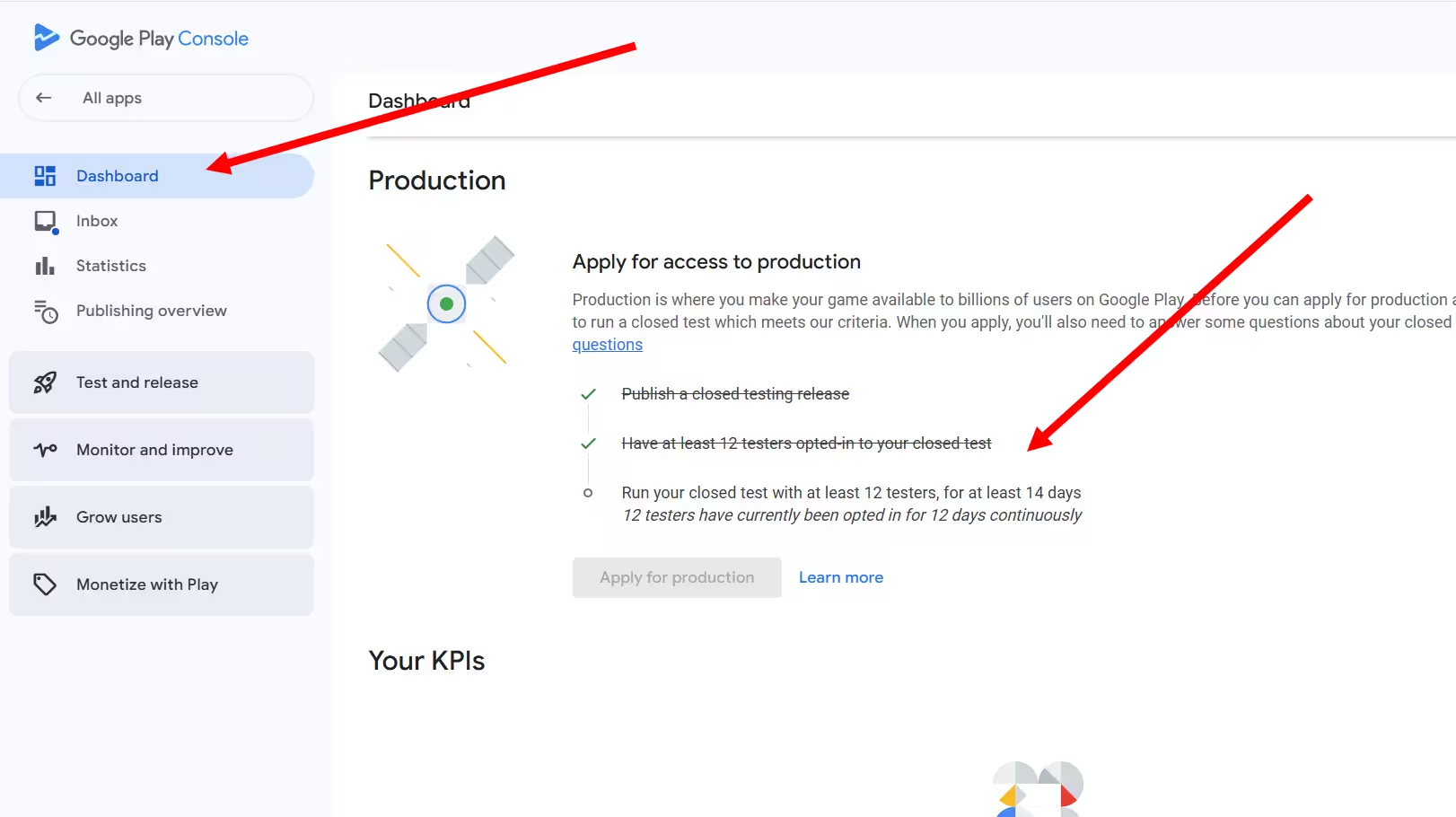
An ordinary update keeps your testers' opt-in time runningGoogle publishes no rule that creating a new release restarts closed testing. The requirement is about each tester staying opted in for 14 continuous days, with at least 12 such testers when you apply. Your version code and the number of builds you upload are not part of it.
Testers leaving the test, so fewer than 12 have 14 unbroken days.
A tester who opts out and rejoins starts their own 14 days again, and a replacement starts from day one. If that leaves fewer than 12 testers with 14 unbroken days, your application waits. The update is not the cause.
Quick Answer
No. Updating the same app on its ongoing closed testing track does not by itself restart your testers' opt-in time. For personal developer accounts created after November 13, 2023, the app needs at least 12 testers who have each stayed opted in for the last 14 consecutive days when you apply for production access. A tester who opts out starts their own 14 days again. Google recommends acting on feedback but publishes no required release count. If testers cannot see a new build, check publication, rollout eligibility and device updating.
It is one of the most common closed testing fears: you are partway through your 14-day window, you spot a bug, and you freeze, worried that uploading a fix will wipe your progress and force you to start the two weeks over. It will not. The 14-day requirement watches your testers, not your builds. This guide separates what interrupts the closed testing window from what does not, gives you two interactive tools to test any action yourself, and explains what to check when testers cannot see a new build. It was last checked against Google's Help pages on October 16, 2026.
In This Guide
Does Updating My App Reset the 14-Day Closed Testing Clock?
No. This is the single most common fear among developers in their testing window, and the answer is reassuring: uploading a new app bundle to your existing closed testing track does not by itself restart your testers' opt-in time.
The 14-day requirement is tied to your testers, not your build. Google measures it per tester: when you apply for production access, at least 12 testers must each have been opted in for the last 14 days continuously. Your app's version number, how many times you upload a new AAB, and what you change in your release notes are not part of that requirement.
This exact question comes up again and again on the Google Play Developer Community. Google's Play Console Help defines the requirement purely in terms of opted-in testers and time, never in terms of build uploads. A Google Product Expert gave the practical answer directly in an accepted community reply in January 2024: an update during testing may need a review, but it does not reset the 14 days. That is an expert reading of the policy, not a sentence from the policy itself.
Not sure about a specific action? Use the checker below: pick what you are about to do and it tells you whether it touches your testers' 14 days.
Which action are you worried about?
Based on Google's published Play Console requirement (opted-in testers x continuous days) plus widely reported developer experience. The two community-flagged risks are marked as such.
What Actually Resets the 14-Day Timer?
The continuous 14-day window is best understood as a consistency check, not a passive calendar countdown. Google wants to see that you held at least 12 opted-in testers without interruption. There are only two confirmed triggers that break that continuity:
Opted-in count drops below 12
If one tester leaves and you fall to 11 qualifying testers, you cannot apply until a twelfth tester has 14 unbroken days, and a replacement starts from day one. This is why running at exactly 12 is risky.
Testers formally opt out
A tester opts out by opening the testing web link and choosing to leave. This is different from uninstalling. That tester's own 14 days stop, and rejoining starts them again. It delays your application only if it leaves fewer than 12 qualifying testers.
Uploading a new build is not on that list. Neither is fixing a typo in your store listing, a tester submitting feedback, nor your app crashing on a tester's device - that last one is the entire point of testing. The simulator below makes the difference obvious: hammer the update button and nothing moves, but lose testers below 12 and the streak collapses.
What does NOT reset the clock
Uploading a new AAB to the same track
Editing release notes or store listing
A tester submitting feedback
Your app crashing on a tester's device
Bumping your version code or version name
A tester uninstalling without opting out
How Do I Push an Update to a Closed Test?
Pushing an update is the same flow as your very first release, with one important difference: you create the new release on the same closed testing track your testers are already opted into. You are not starting a new test - you are adding a build to the test already running, which is exactly why the 14-day clock keeps ticking. Here are the two steps in Play Console.
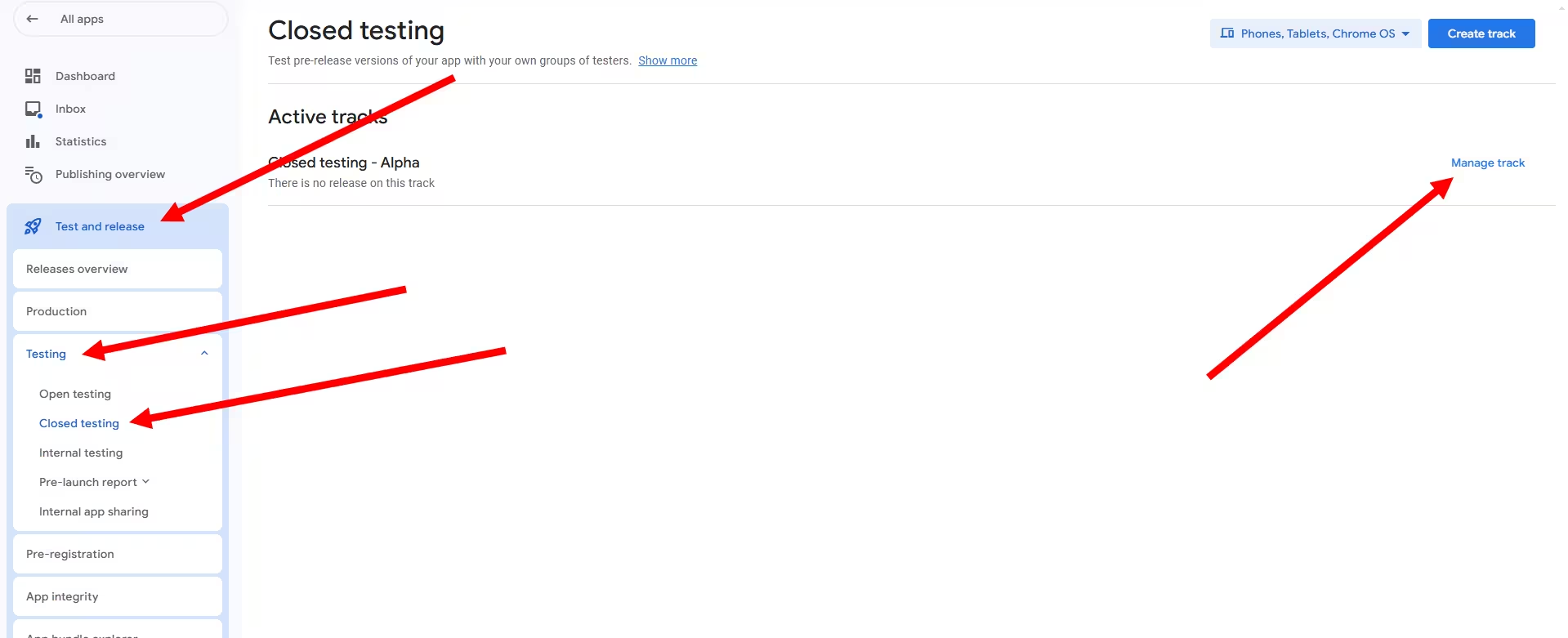
Create a new release on your closed track Test and release > Testing > Closed testing > Manage track
Open the closed testing track you have been running, click Create new release, and upload your updated app bundle (AAB). Keep the same package name and signing setup, and give the build a higher versionCode: changing only the versionName is not an upgrade. Add short release notes describing what changed, then save. Keep it on the same track; that is what keeps your testers' 14 days running.
Review and roll out the update Review release > Start roll-out
Step through Next and Review release, then start the roll-out to your closed track. Then open Publishing overview: if changes are waiting, choose Send changes for review, and if managed publishing is on, publish the approved changes yourself. A submitted update can show In review before testers receive it, and Google notes a published change can take several hours to reach testers. Existing testers normally update in place, with no reinstall and no second opt-in.
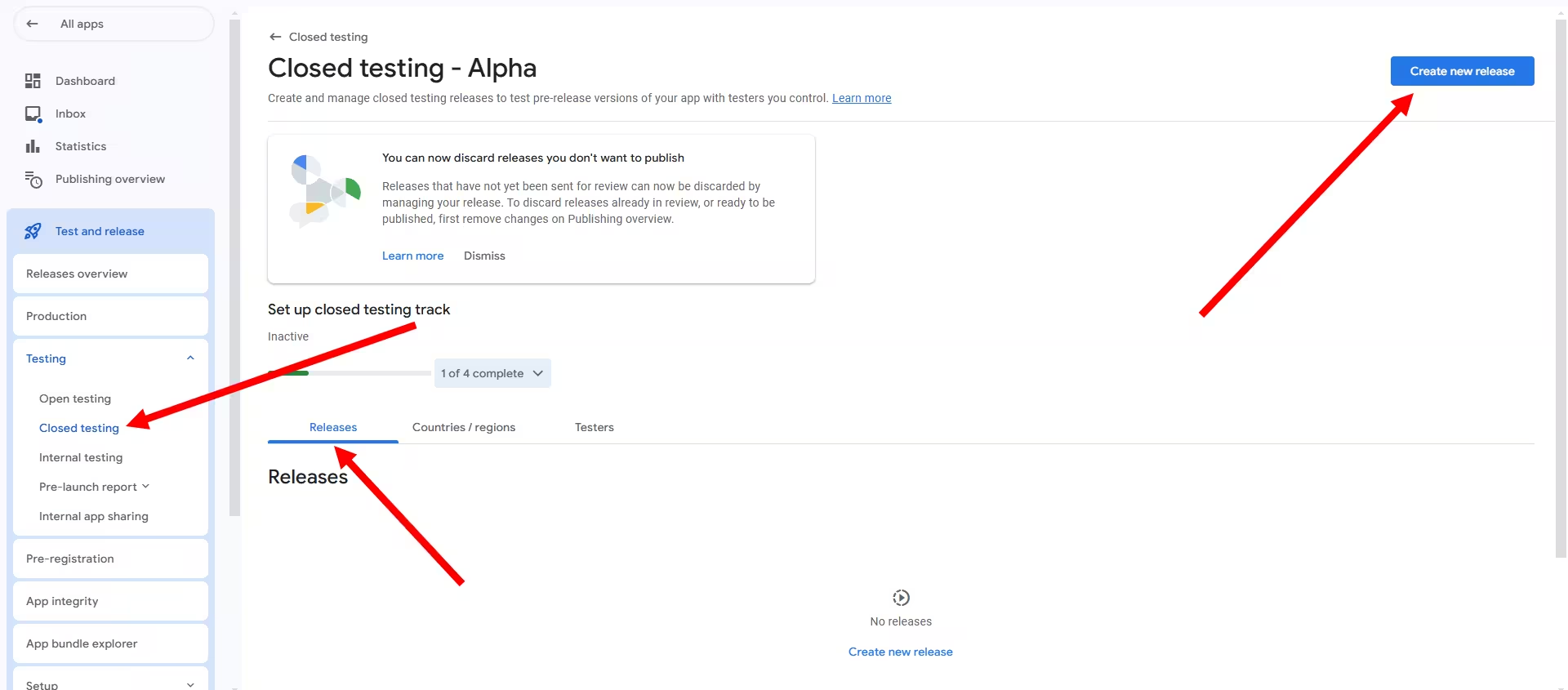
This does not restart your testers' opt-in time. Because you release onto the same closed track your testers are already opted into, their 14 days keep running underneath the new build. You are adding a build, not starting a new test. If testers still cannot see the new build, work through the checks in the next section.
Why Are Testers Not Getting the New Build?
First check whether the intended build is published to the tester's track, then check the tester's account and the installed version, and only then the phone. This is an order of checks, not a ranking of the most common causes. You are done when an eligible tester has installed the intended build and retested the change; a new date on the store listing is not enough.
My update is still in review
A submitted update can need review before that build reaches testers. Open Publishing overview in Play Console and act on what it shows:
- Changes not yet sent: review the list and choose Send changes for review.
- In review: confirm it is the right app, track and version, and follow any message in the Console. Do not upload another build just to refresh it; Google counts review time from the last submitted change.
- Changes ready to publish: managed publishing is on, so publish the approved changes yourself.
A release waiting for review and your testers staying opted in are separate states. Google does not document an ordinary update review as pausing or resetting your testers' opt-in time.
Only some testers can update
A published update reaches only the testers it is rolled out to and eligible for. Check these in order:
- Staged rollout: updates on test tracks, closed testing included, can use a rollout percentage, and it does not rise on its own. In Closed testing > Releases, open Manage rollout to see the percentage and whether the rollout is halted.
- Account: the address on your list or in your Google Group, the account that opted in, and the account signed in to the Play Store must be the same.
- Internal testing: a tester still opted in to your internal test is not eligible for closed testing builds until they leave the internal test and join the closed one. That is an enrollment repair, not a routine update step.
- Version code: Google Play installs the highest compatible versionCode the tester is eligible for. Changing the versionName alone is not an upgrade.
- Device: the build must support the tester's device, and your distribution settings must include it.
The release is available, but the phone still has the old build
Use the Play Store's own update path before you touch the tester's enrollment:
- Open the app's Play listing through your test link and tap Update if it shows, or go to your profile > Manage apps & device > Updates available.
- Check auto-update: it can be off, limited to Wi-Fi, or turned off for this one app.
- Check the connection and free storage, then close and reopen the Play Store.
- Only then clear the Play Store cache (app info > Storage & cache > Clear cache). Clearing the cache cannot publish a release that is still in review.
Do not ask testers to leave the test and rejoin to get an update. Leaving breaks that tester's 14 unbroken days. Uninstalling the app, clearing Google Play services data or resetting the phone is not part of a normal update either.
What Is the Difference Between Invited and Opted-In Testers?
This distinction trips up more first-time publishers than any other, and it is the key to understanding why builds do not matter to the clock. Google's system moves testers through a funnel, and only the later stages carry weight.
Invited
You added an email address to your tester list or Google Group. Nothing more has happened yet.
Opted-in
They clicked your opt-in link, signed in with their Google account, and chose Become a tester. This is the status the 14-day clock measures.
Installed & active
They downloaded the app and keep using it. This does not change the raw count, but it is what Google weighs for engagement at production-access time.
As Google's documentation makes clear, adding an email is not enough. Each tester must open the opt-in link, authenticate, and explicitly become a tester before they count. This is also why an ordinary app update does not restart your progress: your testers stay opted in, so their days keep counting across new builds. For a full walkthrough, see our guide on how to invite testers correctly.
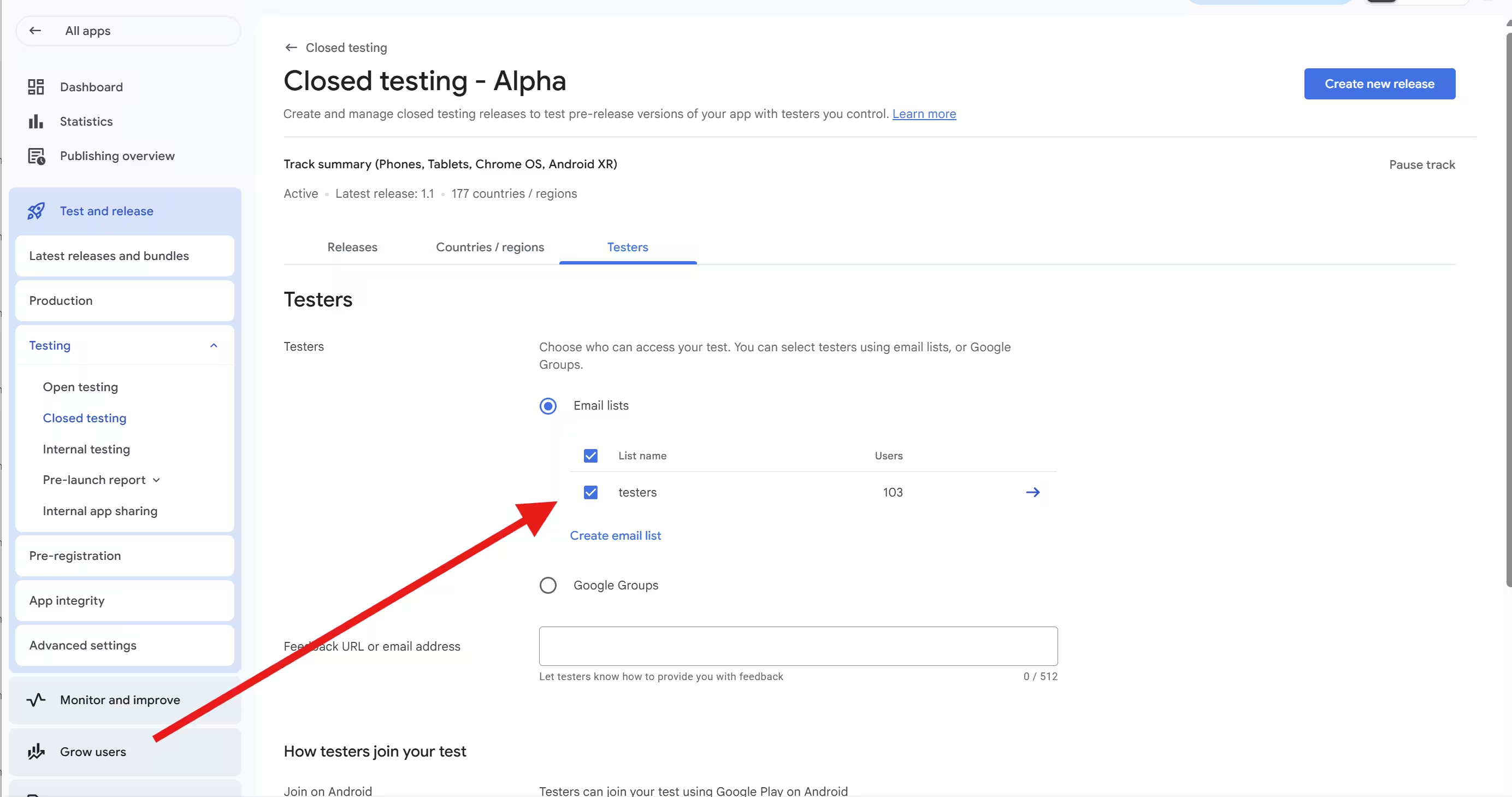
Tip from managing thousands of tests: run your testers through a Google Group rather than a static email list. Google documents that uploading a CSV overwrites the previous tester list, so a Group avoids accidentally wiping active testers while you adjust it. A Group is not a guarantee, though: membership still controls access, so removing someone from the Group or linking a different Group changes who is eligible.
What Is the Exact Google Requirement Wording?
Google's official Play Console Help page, "App testing requirements for new personal developer accounts," states it precisely:
"If you have a newly created personal developer account, you must run a closed test for your app with a minimum of 12 testers who have been opted-in for at least the last 14 days continuously."
Google Play Console Help · answer 14151465And separately, on the moment you apply for production access:
"At least 12 testers must be opted-in to your closed test when you apply for production access. They must have been opted-in for the last 14 days continuously."
Google Play Console Help · answer 14151465Google also spells out, in its own words, that the days must be consecutive: it will not count testers who opted in, tested for less than 14 days, and then opted out, and even if they opt back in, the 14 days must be consecutive to count. That single clause kills the "14 days is cumulative" myth on its own - and, just as importantly, it says nothing about your builds.
Three facts to lock in
Is Pushing Updates During Testing Good or Bad?
This is where developer anxiety flips into opportunity. Pushing updates during your closed test is widely viewed as a positive engagement signal. It is worth separating what Google officially says from what the developer community has concluded, because the two overlap without being identical:
Keep iterating and fixing
Play Console Help encourages ongoing iteration: continue to use closed testing while you fix user-reported issues and bugs, and updating your app in closed testing before going to production is "a great way to minimize low quality reviews and ratings."
When you apply for production access, the questionnaire asks you to describe the engagement you received and what you did with tester feedback.
Active beats frozen
Practitioners go further: an app frozen at version 1.0 for 14 days with zero activity looks like check-the-box testing, while one that ships fixes in response to feedback looks like genuine development. Some developers push two or three small updates to show responsiveness, but Google publishes no such quota (see the release count section below).
This is community opinion and reasonable inference, not a published Google rule. Google has set no numeric "ship X updates" requirement.
The takeaway: updating is safe and encouraged, and the engagement story you build with it can help you answer the production-access questionnaire. The only real risk comes from what you ship, not the act of shipping - which leads to the one genuine caveat.
Do I Need Two or Three Releases During Closed Testing?
Google's published closed-testing guidance does not set a minimum number of releases. It recommends acting on tester feedback and fixing the problems testing finds, and the production access application asks you to describe any changes you made. A count of uploads is not part of the requirement.
- Keep at least 12 testers opted in for 14 unbroken days (published requirement)
Protect each tester's unbroken opt-in from the first day. - Act on feedback and fix the problems testing finds (Google guidance)
Keep a short record of the feedback, the fix and the retest. - Ship two or three releases whatever happens (community folklore, no published quota)
Do not manufacture changes, and do not expect a release count to win approval.
Where the advice comes from: the earliest explicit version we located is a developer's guess, in an October 2024 discussion, that two or three updates might show Google feedback-driven work. It was repeated in community threads within weeks and later appeared in guides as if it were a Google recommendation. The original source is unknown, and developers report rejections both with and without several updates, so a release count proves nothing on its own.
If testing finds a real problem, fix it, ship the build and ask testers to retest. If it does not, say so honestly when you answer the production access questionnaire. Uploading cosmetic builds while an update is in review can also push your app back in the review queue, because Google counts review time from the last submitted change.
Can a Bad Update Reset My Clock Indirectly?
Yes - and this is the one caveat that matters. While the act of updating never resets the timer directly, the consequences of a broken update can. Follow the chain:
So the rule is simple: update freely, but vet each build for baseline stability before pushing it to your closed track. And never run at exactly 12 testers, because a single opt-out from a bad build can sink you. A buffer of testers above 12 absorbs that risk.
Read the chain carefully: the update does not restart anyone's opt-in time. The delay comes from losing qualifying testers; the broken build is only what triggered the opt-outs. Keep your builds stable and keep a buffer, and the indirect risk becomes much smaller.
Do Testers Need to Re-Install or Re-Opt-In After an Update?
No. Existing testers who have opted in and installed your app normally update through Google Play in place. They do not need to opt in again, and you do not need to re-send the link.
Updates normally install in place
Google's Play Console Help, in Set up an open, closed, or internal test (answer 9845334), states it plainly: "Once your testers have installed your app, they'll automatically be updated to use the test version within a few minutes." Testers stay opted in across every build - no reinstall, no second opt-in click.
One timing caveat from that same Google page: when you publish additional changes, they "may not be available for testers for several hours" before the automatic on-device update kicks in. But the testers' opted-in status - which is what the 14-day clock measures - carries forward across each new AAB regardless. This is exactly why a build update does not reset the clock: the testers never left.
Important exception New permissions can interrupt the silent update
One kind of build does not always roll out silently: an update that adds a new dangerous (sensitive) permission such as ACCESS_FINE_LOCATION, camera, or microphone. Depending on the permission and your target API level, Google Play may surface an Update that the tester has to tap and approve by hand instead of installing it in the background - and anyone who ignores it stays parked on the old build. Even when it does install silently, the new permission is only granted at runtime, so a permission-gated feature can look broken until the tester allows it.
In a closed test that is a quiet trap: push a permission-heavy update mid-test and some testers can stay on the old build or find a feature blocked until they allow the permission. A new high-risk permission can also need a Permissions declaration in Play Console before the build can publish at all. Runtime consent on the phone and the Console declaration are separate checks.
Before you roll out mid-test: diff your new manifest's permissions against the live build. If the permission set changed, message your testers to open the Play Store and update manually (and grant the new prompt), and budget for a possible declaration review.
Common Closed Testing Myths, Debunked
Most of the panic around updating comes down to a handful of myths. Here are the five that cost developers the most sleep, with what is actually true:
Myth 1"Creating a new release resets the clock."
Myth 2"Uninstalling equals opting out."
Myth 3"The 14 days is cumulative."
Myth 4"Exactly 12 testers is enough."
Myth 5"Testers must use the app every single day."
What Resets the Clock vs What Does Not
Here is the whole question on one screen. Save it, screenshot it, or send it to whoever on your team keeps asking. Anything tied to your build is safe; only things tied to your tester count are not.
| Action | Resets the 14-day clock? |
|---|---|
| Uploading a new AAB to the same closed track | No |
| Editing release notes or store-listing metadata | No |
| A tester submitting feedback | No |
| Your app crashing on a tester's device | No |
| A tester uninstalling (without opting out) | No* |
| Opted-in tester count dropping below 12 | Yes |
| A tester formally opting out via the web link | Yes** |
| Pushing a broken build that drives opt-outs below 12 | Indirectly |
| Pausing the closed testing track | Reported risk |
| Overwriting your tester list and omitting active testers | Reported risk |
* Not an opt-out, but a tester without the app installed is not testing it. ** Only if it leaves fewer than 12 qualifying testers. "Yes" here means your earliest application date moves out: testers who stayed keep their days, but a replacement starts from day one. Google documents that a CSV upload overwrites the previous list and that pausing a test stops updates to it; how the days are counted afterwards is not documented, so treat the last two rows as "do not risk it".
How the Requirement Has Changed Over Time
If you are reading older tutorials, this is why the numbers do not match. The duration has always been 14 continuous days; only the tester count moved.
Before November 2023 there was no required closed test to reach production. You could publish without recruiting testers.
Google announced the requirement on November 9, 2023. Personal accounts created after November 13, 2023 had to run a closed test with 20 opted-in testers for 14 continuous days. Organization accounts were exempt.
On December 11, 2024 the minimum dropped from 20 to 12, with the 14-day duration unchanged. Organization accounts remain exempt.
Any guide still telling you to recruit 20 testers is out of date. We cover the switch in detail in what changed from 20 to 12 testers.
2026 Policy Changes You Should Know About
Closed testing does not exist in a vacuum. A few 2026 deadlines can intersect with your launch timeline - none of them change how the 14-day clock works, but they can collide with your window if you are not watching the calendar:
2026 deadlines that intersect your timeline
Dates per Google Play Console Help (target API level) and the Android Developers Blog (developer verification). Verification timing is phased and may expand across 2026-2027, so confirm against the official pages before you plan around it. Our 2026 publishing requirements guide tracks the full list.
How PrimeTestLab Keeps Your Clock Running
The hardest part of closed testing is not understanding the rules; it is keeping 12 or more real humans opted in and engaged for 14 unbroken days while you iterate. That is exactly what PrimeTestLab is built for. We provide real-device, opted-in testers and guide your Play Console setup so the clock starts cleanly and stays running while you ship fixes. See our full Google Play closed testing service for what is included. We maintain a 99.9% success rate across 12,100+ apps, with testing live in 4-6 hours.
You add our testers in Play Console, share your testing URL, and the 14 days start. From there you can ship updates when you need to; the testers stay opted in while you iterate.
A plan above the 12-tester minimum gives you extra testers who start on the same day, so one opt-out, including one caused by a bad build, does not leave you short of 12. A buffer only helps if those testers opt in early: a late replacement starts their own 14 days. Prices are per app, plus a 5% service fee ($1.50 minimum) at checkout.
Frequently Asked Questions
Can I update my app during closed testing without restarting the 14 days?
Yes. An ordinary update to the same app on its ongoing closed track does not itself restart tester opt-in time. Keep your existing testers eligible and opted in. The new build may still need review and publication before testers can install it, so check delivery separately from the testing requirement.
What is the only thing that resets the closed testing clock?
Google publishes no reset checklist covering every Console action. The requirement concerns each tester's continuous opt-in. A tester who leaves and rejoins starts their own 14 days again, and losing enough qualifying testers can delay your application. A new replacement starts from day one. An ordinary build update is a different event.
What is the difference between invited and opted-in testers?
Invited means the account is on your tester list or in your Google Group. Opted in means the tester opened the test link with that account and joined the test. Listing an address alone does not complete enrollment. Ask testers to confirm the account, then install, use the app and send meaningful feedback.
Do testers have to re-opt-in after I push an update?
Normally, no. Existing eligible testers receive an ordinary update through Google Play without joining the same test again. Keep their enrollment intact, then ask them to check the listing and the installed build. Automatic installation depends on the release being available and on device settings, so do not promise every tester the update within minutes.
Is uninstalling the same as opting out?
No. Uninstalling removes the app from a phone; opting out changes participation in the test. Neither today's install count nor today's invitation list proves continuous enrollment. A tester who uninstalled also cannot test that installation, so confirm they are still in the test and ask them to reinstall and keep testing.
Does Google want me to push updates during the test?
Google recommends acting on tester feedback and fixing issues, and the production access application asks what you changed after testing. It does not publish a required number of releases. Ship useful fixes when you need them, record what changed and retest them. Do not ship cosmetic releases just to satisfy a supposed two or three update rule.
How many testers do I really need for closed testing?
For personal accounts created after November 13, 2023, the minimum is 12 testers who have each stayed opted in for the last 14 consecutive days when you apply. Recruiting extra testers early gives you a buffer. Replacements added late do not inherit the days of testers who left, and no tester count guarantees production access.
Do I have to release two or three updates to pass?
Google's published guidance does not set that quota. It asks about testing, feedback, changes and readiness. If testing finds a real issue, fix it and record the retest. If it does not, describe the testing honestly. A release count alone neither proves useful testing nor guarantees that production access will be granted.
My release is available, so why is my tester still on the old version?
Check the tester's Google account, their track enrollment, the rollout percentage and the versionCode. Then have them open the Play listing and check for Update. Automatic updating can be turned off or delayed by device conditions. Confirm the build actually installed; the listing's update date is not enough.
Does "In review" pause my 14-day test?
An update in review is waiting for Google to process that build. Google does not document an ordinary update review as pausing your testers' existing opt-in time. Check that the ongoing test is still available and enrollment is intact. Another submission can delay the release review, which is separate from the continuous testing requirement.
Should testers leave and rejoin to get the update?
No. Leaving and rejoining the closed test is not an update fix, and it breaks that tester's consecutive opt-in days. First check publication, the tester's account, the rollout and the versionCode, then try the normal Play Store update path. Repair a genuinely wrong enrollment separately, knowing what it does to that tester's 14 days.
Bottom Line
Summary
Updating your app during the 14-day closed test is safe, normal and encouraged. Google measures each tester's unbroken opt-in, so an ordinary update to the same closed track does not restart your testers' 14 days. The real risks are losing qualifying testers, testers formally opting out, or shipping a build so broken that testers quit. Ship real fixes, act on feedback, and protect your tester count with a buffer recruited early. If you want help keeping 12 or more testers opted in, PrimeTestLab provides 12 to 25 real testers from $19.99 plus a 5% service fee ($1.50 minimum), with testing live in 4-6 hours. If production access is not granted after the full test, you choose a free retest or a full refund. See pricing plans →